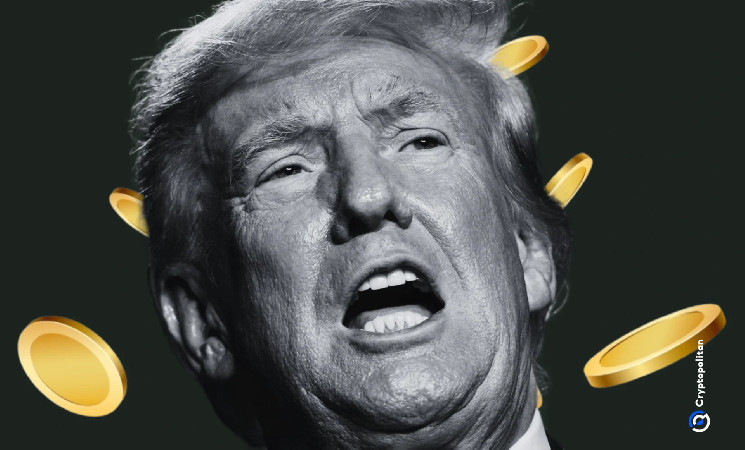
Donald Trump is attempting to be the crypto neighborhood’s very top buddy. In 2019, he known as Bitcoin a scam and mentioned crypto would gasoline crimes.
Like a flash forward to this election 300 and sixty five days, and he’s singing a various tune, calling himself the “crypto president.”
Why the trade? Successfully, it’s easy. He desires votes and money. His advertising and marketing and marketing campaign has already pulled in about $25 million from donations within the trade.
But the abundant query is, can he in point of fact remain expert-crypto if he takes motivate the Oval? Spoiler alert. Doubtlessly now not.
At the Bitcoin convention in Nashville, he promised to contain the U.S. the “crypto capital of the planet.”
He’s speaking about making a Strategic Nationwide Bitcoin Stockpile. This means conserving onto your entire Bitcoin the U.S. authorities has, which is price over $12 billion at press time.
He moreover desires to space up a Crypto Advisory Council, filled with trade insiders to assassinate unique principles.
Oh, and he’s fully towards Central Monetary institution Digital Currencies (CBDCs), calling them a “dangerous risk to freedom.”
He’s gonna blueprint all the pieces in his vitality to cease the Federal Reserve from creating one. It’s all designed to catch the crypto neighborhood on his aspect and to battle what he calls “Biden’s anti-crypto crusade.”
Guarantees vs. actuality
Trump’s guarantees sound abundant on paper, nevertheless they’re now not life like. The Strategic Nationwide Bitcoin Stockpile understanding, namely, is crazy.
Bitcoin is unstable. The utilization of it as a core part of U.S. monetary protection is love playing with fire. The understanding to assassinate a Crypto Advisory Council sounds nice, nevertheless it’s now not distinct how that can work.
Who will seemingly be on this council? How mighty influence will they occupy? Colorful Trump, it’s more seemingly to be stuffed with folks that enhance his trade ventures.
Trump has a unique trade, World Liberty Monetary. It’s allegedly a crypto trading and lending platform. His family owns 70% of it. Right here is a huge battle of hobby.
How can he be both a president and a businessman without mixing the two? Jordan Libowitz from Electorate for Accountability and Ethics in Washington says it’s a recipe for disaster.
The platform claims it’ll leave within the motivate of “unhurried and outdated abundant banks.” But particulars are scarce. Charles Hoskinson, the one that co-based Ethereum and Cardano, is now not joyful. He says:
“Trump is launching a DeFi software, and that’s upsetting to me as an trade.”
Why? As a result of the relaxation Trump touches becomes a political circus. Charles is petrified that the Democrats will weaponize U.S. institutions to unhurried down Trump’s crypto plans.
He thinks there could well be DOJ investigations or SEC lawsuits. And he’s now not disagreeable. If this happens, it’ll assassinate a huge number in your entire trade.
The financial affect
If Trump’s crypto insurance policies seize off, they could maybe per chance per chance moreover have an effect on the economy. He says he’ll push the Federal Reserve to decrease hobby charges by an insanely abundant margin.
This will seemingly be upright for crypto investments nevertheless could well outcome in inflation. The more money folks have to exhaust, the larger the costs mosey. That’s accepted economics.
Then there’s his enhance for decentralized finance (DeFi). Trump thinks DeFi could per chance moreover smash former banks’ stranglehold on finance. But here’s a abundant if. DeFi is restful a Wild West.
There’s various scams and hacks going down every other day. How does Trump understanding to manage it without killing its innovative spirit? He hasn’t mentioned.
Trump moreover desires to subsidize Bitcoin mining. He thinks this can boost vitality manufacturing. It sounds upright, nevertheless it’s now not that uncomplicated. Bitcoin mining makes use of various electrical energy.
This could maybe per chance per chance moreover stress vitality grids and hike up vitality costs. No longer to mention the environmental affect. Crypto mining isn’t precisely green.
CBDCs are one other sizzling topic. They could well centralize vitality within the fingers of the authorities. They could well destabilize the monetary machine.
If folks beginning inspiring their money from banks to CBDCs, banks could per chance moreover urge into liquidity issues. It’s a domino carry out that can moreover trigger a monetary crisis.
In times of business stress, folks could well bustle to convert their monetary institution deposits into CBDCs, making issues even worse.
Privacy is one other self-discipline. CBDCs would seemingly require tracking and identification. This could maybe per chance per chance moreover outcome in authorities surveillance.
People don’t need the convey taking a look over their shoulder whenever they exhaust money. Cybersecurity is moreover a location. A breach within the CBDC machine could well be catastrophic. It’s a abundant, juicy goal for hackers.
Voter approach
Trump’s admire affair with crypto is moreover about votes. The crypto crowd skews younger and male. They’re customarily anti-establishment and drained of authorities meddling in finance.
By leaping on the crypto practice, Trump is hoping to acquire over these disappointed voters. But he’s moreover alienating former Republicans who’re cautious of crypto’s volatility and security issues.
Charles isn’t jubilant Trump can recount on his guarantees. He says Trump’s workers turnover is too high. And doesn’t mediate Kamala Harris would be any larger.
He calls her a continuation of Biden’s disastrous insurance policies. So, it’s a lose-lose location for the crypto trade.
Trump has enhance from high folks in crypto love Marc Andreessen, Ben Horowitz, and the Winklevoss twins.
But he’s now not the simplest one. Designate Cuban and Reid Hoffman are backing Kamala. The crypto neighborhood is divided.
Charles says, “I don’t search for that stage of quality and class within the discourse” from both candidate.
He thinks the U.S. could per chance moreover contain “5 to 10 trillion price of crypto stuff” over the next decade if the authorities would genuine catch its act collectively.
He’s more optimistic about Congress. He mentioned he’s had upright talks with Republicans love Tim Scott and Cynthia Lummis, and even Democrat Ron Wyden.
Charles warns that Trump is making crypto a partisan self-discipline. That’s deplorable files. Crypto has repeatedly been bipartisan. Turning it valid into a political soccer could per chance moreover space the trade motivate years.
If Trump goes down, he could per chance moreover seize your entire trade with him.