

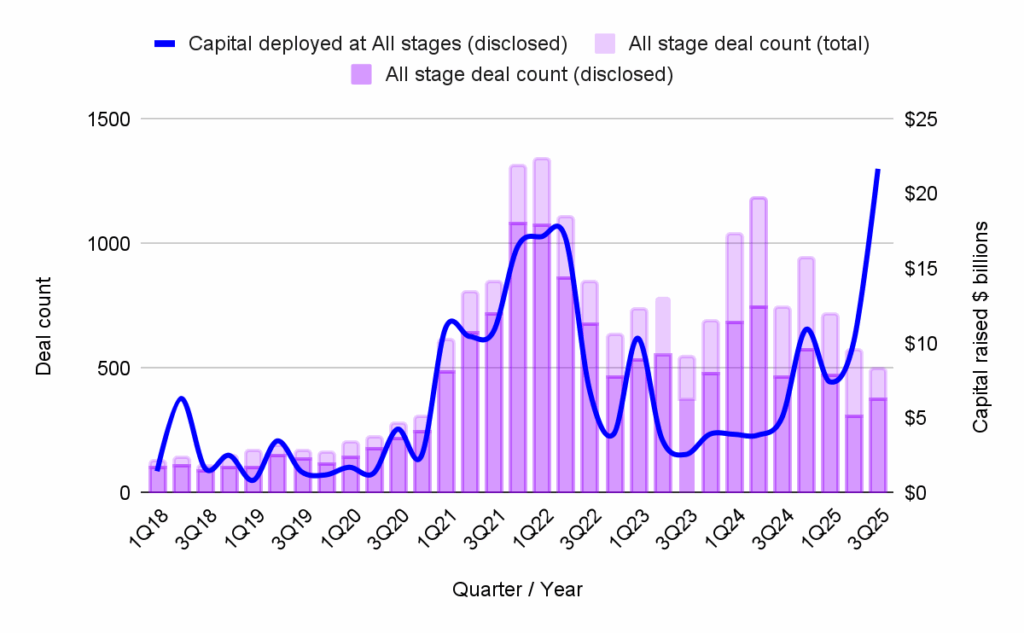
The global Web3 venture capital landscape experienced a historic realignment in the third quarter of 2025, with total capital deployment reaching a cycle high of nearly $22 billion across 376 disclosed deals. According to comprehensive data compiled by Outlier Ventures and Messari, total funding surged by 113% quarter-on-quarter, jumping from $10.2 billion in the second quarter to $21.7 billion in the third. This remarkable influx eclipsed even the peak transactional periods of the 2021 and 2022 bull markets. However, the underlying mechanics of this capital surge reveal a market fundamentally altered by institutional maturity: while total capital more than doubled, deal count grew by a modest 22%. This divergence underscores a prevailing trend of conviction over coverage, characterized by larger, highly concentrated cheques directed primarily toward compliance-ready infrastructure and traditional finance integration rather than a broad-based recovery in early-stage venture activity.

The Evolution of Institutional Architecture and TradFi Convergence
The third quarter of 2025 marked a definitive turning point where the intersection of cryptocurrency and traditional finance (TradFi) transitioned from experimental pilots to operational scale. Institutional financial rails deepened significantly, anchored by the explosive growth of Ethereum-focused exchange-traded funds (ETFs) and Digital Asset Treasuries (DATs). Data from Messari’s Q3 review indicates that ETH-centric ETFs absorbed approximately $8.7 billion during the quarter, outpacing Bitcoin-focused funds for the first time and lifting total ETH ETF assets under management by 170% quarter-on-quarter to $27.4 billion. Simultaneously, DATs secured roughly 3.8% of the total circulating Ethereum supply, signaling a structural evolution in corporate treasury management.
Enterprise adoption moved swiftly beyond theoretical proofs-of-concept. Major traditional financial institutions operationalized blockchain infrastructure at scale. JPMorgan’s Kinexys network went live for the settlement of tokenized repurchase agreements, while SWIFT expanded its tokenized asset trials in collaboration with global custodians such as BNY Mellon, Citi, Clearstream, Euroclear, and Northern Trust to test cross-network bond and fund share settlements. Furthermore, Visa Direct initiated the processing of cross-border payments utilizing USDC. These systemic developments provided the foundational demand underpinning the massive capital allocations observed in later-stage Web3 infrastructure rounds.
Complementing these technological deployments, regulatory and policy frameworks grew increasingly favorable throughout 2025. Following the implementation of legislative milestones like the GENIUS Act, global banking authorities—including the Monetary Authority of Singapore via DBS—noted a distinct shift from regulatory consultation to commercial execution. These policy catalysts lowered administrative barriers for institutional participation, enabling risk-averse allocators to deploy capital with greater regulatory clarity.
Capital Concentration Across Market Categories and Public Markets
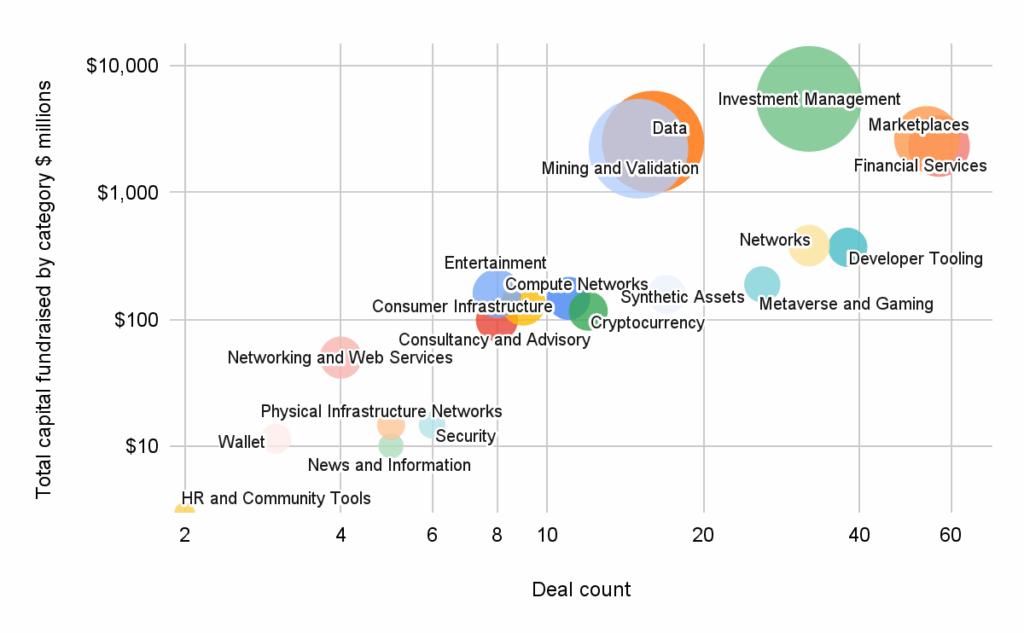
The deployment of $21.7 billion in capital was heavily concentrated within specific, revenue-generating segments of the Web3 ecosystem. Investment Management, Marketplaces, Data Infrastructure, Financial Services, and Mining and Validation collectively absorbed roughly 70% of all venture dollars in the third quarter. These sectors benefit directly from the tailwinds generated by ETF inflows, tokenization programs, and institutional custody requirements. Data infrastructure projects, in particular, captured substantial late-stage investments, bolstered by the formal recognition of AI-crypto stacks as distinct investable categories by research firms like Grayscale.
Conversely, consumer-facing verticals such as Metaverse, Gaming, Wallets, and Security remained peripheral to the primary capital flows. Venture allocators demonstrated a clear preference for infrastructure rails over speculative retail applications, prioritizing sectors where business models, regulatory compliance, and revenue generation are readily legible.
This institutional bias extended to capital formation strategies, where public-market routes experienced a pronounced resurgence. Public token sales climbed to 47 separate events generating a combined $819 million, while private token sales contracted to just 7 events totaling $331 million. Bolstered by rising cryptocurrency market capitalizations and trading volumes documented in CoinGecko’s Q3 industry reports, project teams increasingly favored public distribution channels for transparent price discovery and community alignment. Furthermore, the intermittent reopening of initial public offerings (IPOs) for prominent blockchain enterprises served as a vital market sentiment indicator, functioning as a de facto regulatory-compliance certification mark for institutional investors.
Chronological Analysis of Early-Stage Fundraising Pressures
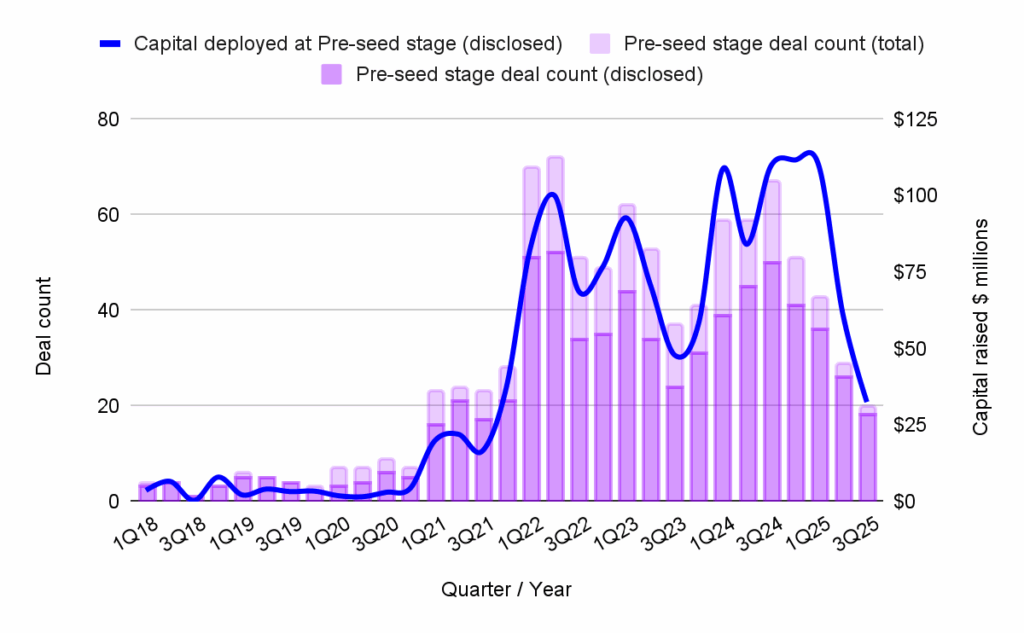
Despite headline-grabbing figures at the aggregate level, the early-stage fundraising environment remained exceptionally rigorous and selective. The pre-seed segment experienced one of its weakest quarters in years, recording merely 18 disclosed rounds totaling $32.5 million, with the 12-month running median slipping below $2.5 million. This contraction was compounded by a notable slowdown in accelerator program activity, creating a highly restrictive funnel for nascent founders.
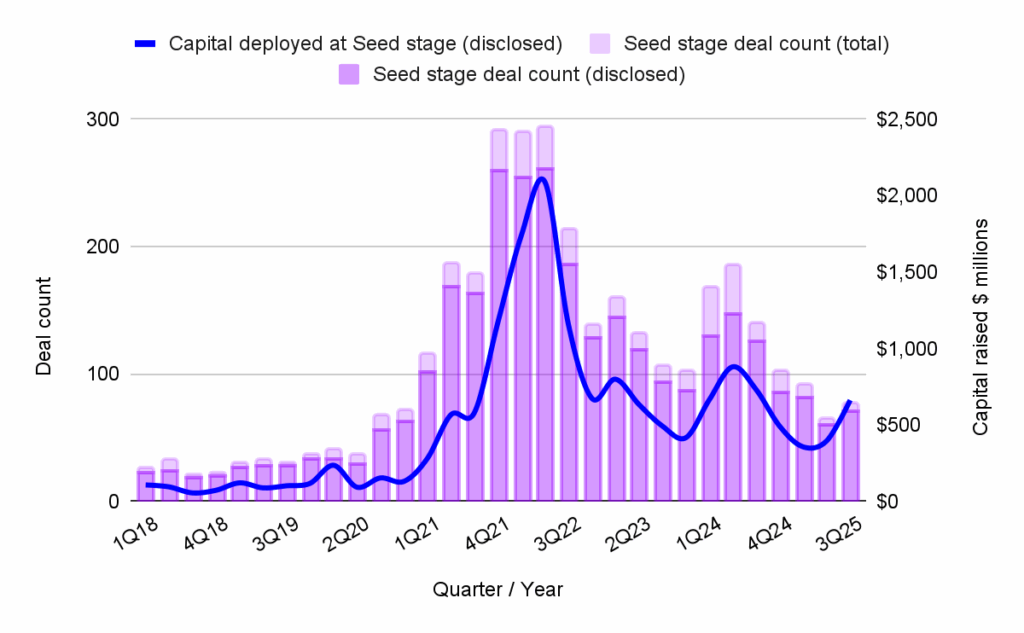
Seed-stage fundraising presented an apparent recovery, logging 71 disclosed rounds amounting to nearly $663 million. However, aggregate metrics were heavily skewed by exceptional transactions, most notably Flying Tulip’s $200 million seed raise. Rather than utilizing traditional illiquid SAFE or SAFT agreements, the round utilized an innovative on-chain structure granting investors capital and yield exposure through callable, yield-bearing instruments deployed in decentralized finance (DeFi) protocols. Excluding this outlier, seed funding remained closely aligned with the subdued levels of preceding quarters.
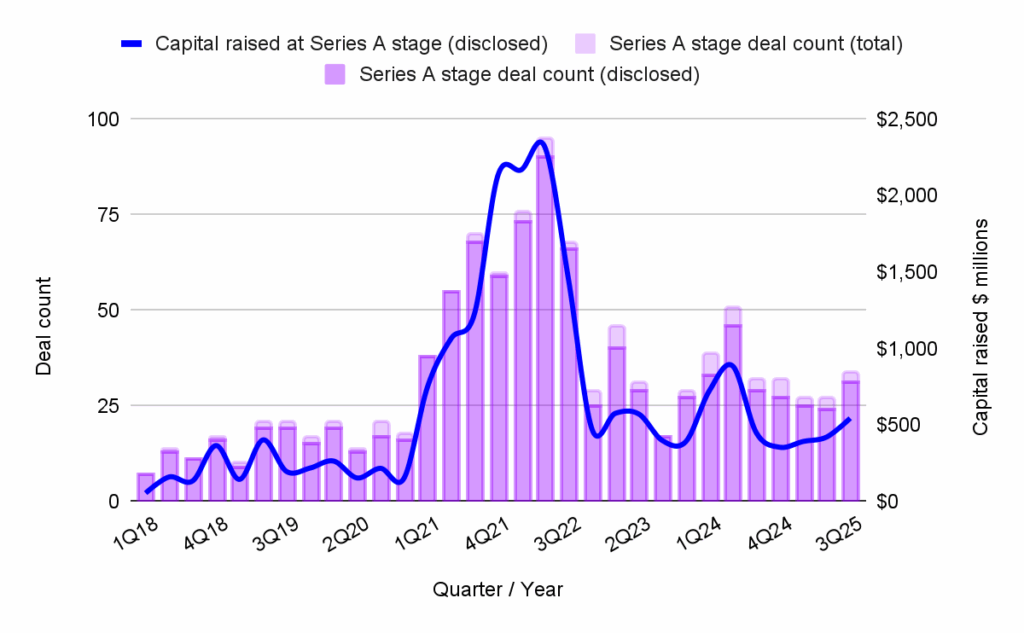
Series A fundraising demonstrated relative stability, recording 31 disclosed rounds totaling approximately $545 million, with a steady 12-month median hovering around $16 million. Mid-stage investments consistently favored projects showing direct operational alignment with institutional payment rails, tokenized asset markets, and data services.
Venture Fund Formation and the Secondary Market Recycling Phase
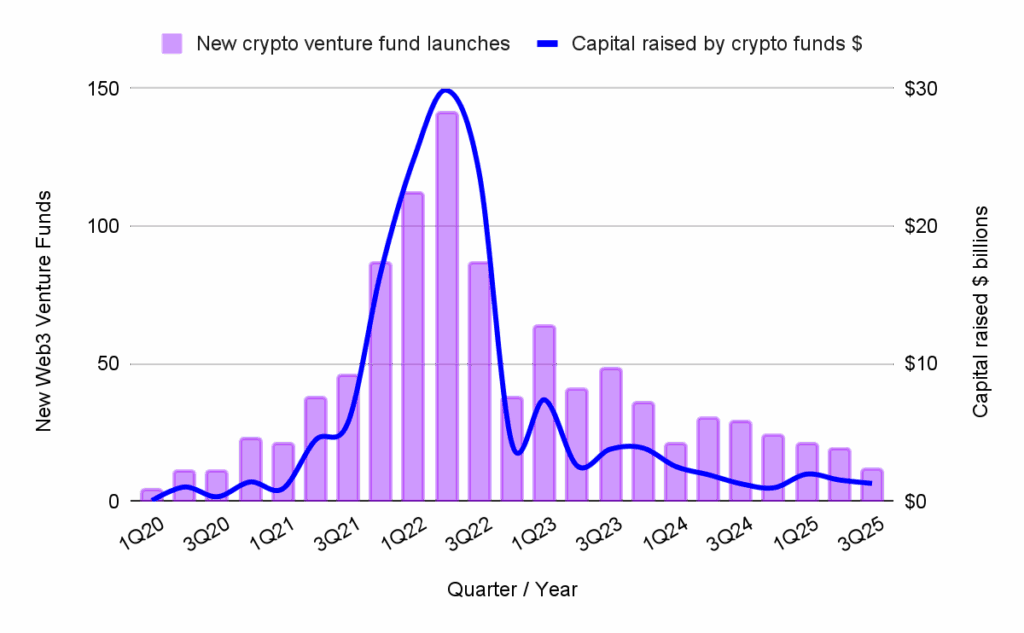
The creation of new crypto-native venture capital funds remained subdued. Only 11 new funds were established in the third quarter of 2025, raising a cumulative $1.3 billion and continuing a downward trajectory observed throughout the year. The pace of new fund formation dropped to levels comparable to mid-2020, driven not by systemic crisis, but by strategic caution among general partners and limited partners alike.
Rather than committing to fresh mandates, venture capital firms increasingly relied on existing dry powder reserves. According to secondary market analyses from PM Insights, the broader market entered a recycling phase, wherein capital circulated primarily through secondary trades, strategic acquisitions, and portfolio exits. This dynamic created an operational bottleneck for early-stage founders seeking initial capital infusions, as venture investors demanded rigorous proof of product-market fit, active user traction, and enterprise-grade compliance architectures before committing capital.
Analytical Implications and Outlook for Upcoming Quarters
The dynamics of the third quarter of 2025 illustrate that mainstream crypto adoption is currently materializing at the foundational infrastructure layer rather than the consumer interface. As traditional banking institutions, global payment networks, and asset managers embed blockchain rails into their core operations, venture capital allocators have adjusted their strategies accordingly.
For founders navigating the upcoming quarters, the pathway from early-stage development to institutional scale requires strict adherence to regulatory standards, demonstrable product utility, and interoperability with traditional financial systems. For venture capitalists and institutional allocators, the primary challenge ahead lies in bridging the narrow pre-seed funding funnel to ensure a healthy, sustainable pipeline of innovation entering 2026. Whether the liquidity observed in the third quarter broadens to encompass early-stage ventures or remains concentrated within institutional infrastructure will serve as the definitive test of the market’s trajectory in the cycles to come.

