

The digital landscape is on the cusp of a profound transformation, moving beyond mere automation of tasks to the sophisticated orchestration of human intent. This paradigm shift is being driven by the emergence of the "Agentic Layer" within what is being termed the "Post Web." This new stratum of the technological stack envisions autonomous Artificial Intelligence (AI) agents acting as digital proxies for humans, capable of interpreting complex goals, making independent decisions, and executing actions across decentralized systems. This evolution represents a significant leap from the foundational principles of Web3, which democratized ownership, to a future where agency is programmable.
The genesis of this new internet phase can be traced back to the advancements ushered in by Web3. Web3 introduced a decentralized internet, fundamentally altering how ownership of digital assets and data is managed. Central to this was the advent of smart contracts, which enabled trustless automation of transactions and agreements. This innovation paved the way for new financial and organizational infrastructures, often described as "programmable money." However, the Post Web proposes a further evolution: "programmable agency."
Greysen Cacciatore, a Research Associate at Outlier Ventures, articulated this shift in their analysis, stating, "AI agentic systems mark the beginning of a new paradigm. With their capabilities to orchestrate intention, navigate complex virtual environments, and achieve sophisticated outcomes, they are poised to transform the global economy." This perspective highlights the potential for AI agents to move beyond simple command execution to a more nuanced understanding and proactive pursuit of human objectives.
Understanding Agents: A Distinction from Bots
The term "AI agents" might initially conjure images of the familiar bots and scripts that populate the current internet. However, the distinction is critical and represents a fundamental difference in capability and purpose. While bots are programmed to follow a predefined set of instructions, executing specific tasks based on fixed inputs, AI agents are designed to be goal-oriented and adaptive.
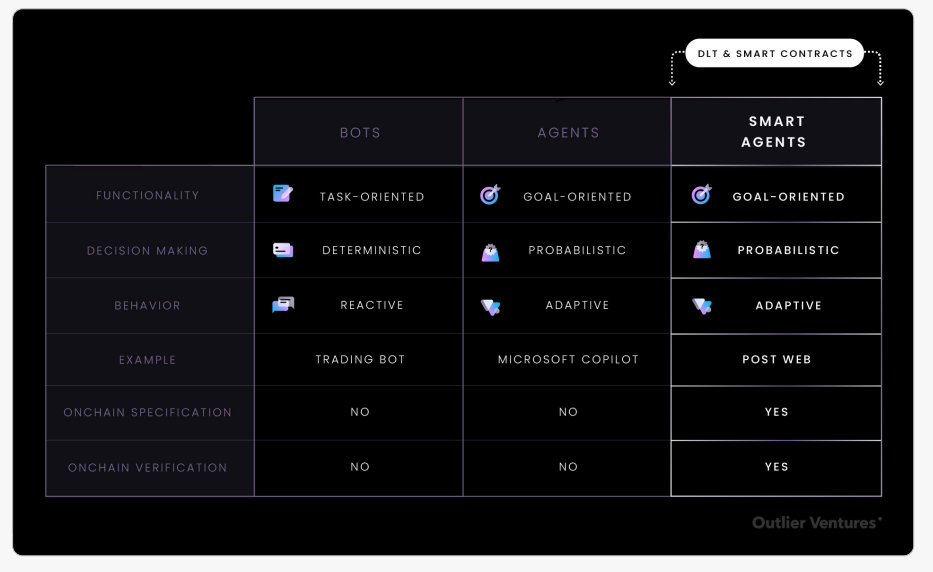
A comparative analysis, as presented in Exhibit 11 from the Post Web thesis, illustrates this divergence. Bots are characterized as deterministic and task-based, reacting to specific inputs with predictable outputs. They lack any capacity for learning or dynamic adaptation. In contrast, AI agents are probabilistic, meaning their outcomes can evolve based on context. They are intent-based and proactive, capable of continuous learning and optimization. This fundamental difference allows agents to operate effectively in complex, dynamic environments, learning from experience and refining their decision-making processes. This level of adaptability and reasoning was largely unattainable within the framework of Web3.
The core distinction lies in what is being automated: bots automate tasks, while agents automate outcomes. This shift transforms digital interaction from a series of predefined commands into a more dynamic, "alive" experience—one that is responsive, context-aware, and capable of reasoning.
Smart Agents: The Economic Powerhouses of the Post Web
Building upon the concept of AI agents, the Post Web thesis introduces "Smart Agents." These represent a next-generation class of AI agents specifically designed to interact directly with distributed ledger technology (DLT) and smart contracts. Unlike traditional agents that might rely on APIs or data feeds, Smart Agents possess the capability to autonomously own tokens, sign transactions, and execute contracts.
In essence, Smart Agents are envisioned as the primary economic participants of the Post Web. Their ability to manage digital assets, verify ownership, enforce agreements, and execute complex workflows in real-time positions them as autonomous economic actors within decentralized systems.
To facilitate their safe and effective operation, two key mechanisms are proposed:
- Decentralized Identity (DID) and Verifiable Credentials (VCs): These technologies allow agents to establish secure, self-sovereign digital identities and present verifiable proof of their attributes and permissions, fostering trust and accountability.
- On-Chain Governance and Reputation Systems: Robust governance frameworks and transparent reputation mechanisms ensure that agent actions align with predefined rules and societal norms, while also allowing for accountability and recourse.
Together, these elements are designed to create a foundational trust framework for autonomous digital economies, where human oversight and cryptographic verifiability are seamlessly integrated.
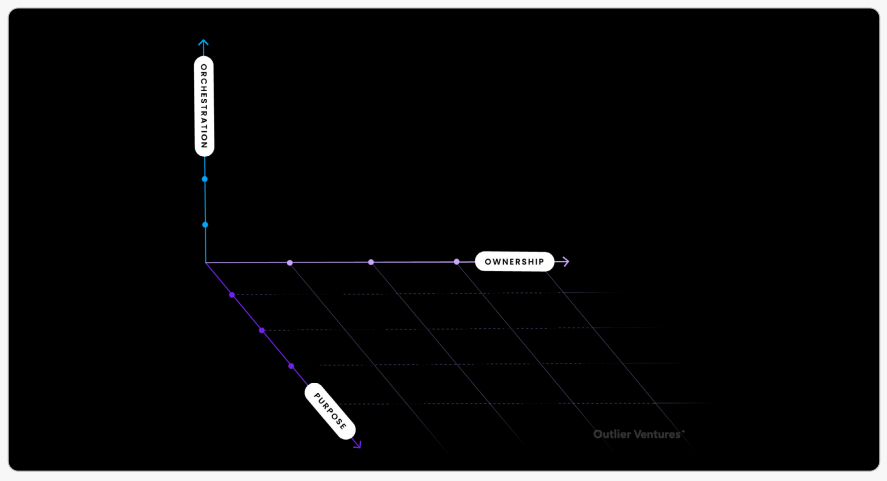
The classification of Smart Agents, as outlined in Exhibit 13, reveals a diverse ecosystem anticipated by the Post Web vision. Agents are categorized along three critical axes:
- Orchestration: This refers to the level of autonomy and complexity in how agents operate, ranging from single-purpose agents to highly sophisticated multi-agent systems.
- Ownership: This axis defines how agents are owned and controlled, whether by individual users, decentralized autonomous organizations (DAOs), or even other agents.
- Purpose: This denotes the specific function or domain for which an agent is designed, such as financial management, data analysis, content creation, or supply chain optimization.
This multifaceted classification suggests a future internet that functions less like a static network and more like a dynamic, interconnected ecosystem, teeming with self-directing entities optimized for efficiency, value creation, and coordinated action.
From Automation to Autonomy: A Conceptual Leap
The progression from Web3 to the Post Web signifies a fundamental shift in how we interact with digital systems. In Web3, smart contracts automated trust, executing actions without intermediaries. However, they still relied on human input to provide intention, initiate transactions, and manage outcomes. The Post Web, through its Agentic Layer, aims to automate intention itself.
This means AI agents will be able to interpret goals expressed in natural language, devise the most effective course of action, and autonomously negotiate with protocols to achieve those objectives. The implications are far-reaching. Consider scenarios such as:
- An agent autonomously managing an individual’s investment portfolio, identifying market opportunities, executing trades, and rebalancing assets based on dynamic risk tolerance and financial goals, all without explicit daily human intervention.
- A supply chain agent optimizing logistics in real-time, rerouting shipments based on weather patterns, geopolitical events, or unexpected demand surges, and automatically adjusting inventory levels across multiple decentralized nodes.
- A personalized learning agent curating educational content, identifying knowledge gaps, and orchestrating the acquisition of new skills through a combination of online courses, simulated environments, and collaborative projects, all tailored to an individual’s learning style and career aspirations.
These are no longer mere theoretical concepts. The convergence of reinforcement learning, advanced natural language models, and decentralized computing infrastructure is laying the groundwork for this "Agentic Layer." This layer is being architected to host and coordinate these intelligent actors, ushering in a new era of autonomous digital operations.
The Significance of the Agentic Layer
The Agentic Layer represents a fundamental architectural evolution of the internet, moving from passive user interfaces to active, autonomous participants. Its significance can be understood through several key advancements:
- Enhanced User Experience: By automating complex tasks and interpreting user intent, the Agentic Layer promises a more seamless and intuitive digital experience, freeing users from the burden of managing intricate processes.
- Economic Efficiency and Innovation: Autonomous agents can operate 24/7, identify new efficiencies, and drive innovation by exploring novel solutions and collaborations within decentralized economies.
- Scalability and Decentralization: The Agentic Layer, built on decentralized protocols, offers a path towards more scalable and resilient digital infrastructure, reducing reliance on centralized intermediaries.
- Verifiable Agency: The integration of DLT and cryptographic principles ensures that agent actions are transparent, auditable, and accountable, fostering trust in autonomous systems.
The Post Web, therefore, is not merely an incremental upgrade but a reimagining of the internet as an intent-based, adaptive, and verifiable ecosystem where humans, agents, and protocols collaborate in a continuous cycle of coordination and value creation.
Interoperability: The Glue of the Agentic Web
As the agentic web takes shape, the principle of interoperability becomes paramount. Drawing from insights by Chris Dixon, the design of network infrastructure dictates who builds and who owns it. Protocol networks, characterized by their openness, permissionless nature, and adherence to shared standards, are crucial for fostering a decentralized and equitable agentic economy. This stands in contrast to closed, rent-seeking corporate networks that can stifle innovation and concentrate power.
For the burgeoning agentic economy, the adoption of interoperable standards is not an ideological preference but a practical necessity. Without them, the risk of replicating the fragmentation and silos of today’s internet is significant. The development and maturation of composable standards, such as those being advanced by entities like Virtuals with protocols like MCPs, A2A, x402, and ACP, are vital. Crucially, their evolution must align with the core ethos of Web3: open-source development, transparency, and an anchor in distributed ledgers that ensure agent accountability.
These protocols will serve as the connective tissue of the agentic web, enabling agents to coordinate, transact, and reason securely and effectively across diverse systems. In essence, the same principles that propelled the decentralization of ownership in Web3 must now be applied to the decentralization of agency itself.
The Web Awakens: A Living Network
The Post Web represents more than just the next generation of digital infrastructure; it signifies the emergence of a "living network"—a web that can understand, adapt, and act. Historically, humans have programmed the internet. In the Post Web era, the paradigm shifts to humans expressing intent, with their AI agents then taking on the responsibility of execution.
This profound evolution promises to fundamentally alter how individuals interact with technology, data, and each other. It is poised to re-architect the web by placing agency at the very core of the digital experience, heralding an era of unprecedented autonomy and intelligent interaction.
Content derived from The Post Web Thesis, Chapter 2: "Turning the Web3 Tech Stack into the Post Web Stack," Outlier Ventures (2025). Cited pages 39–46.

