
In August 2023, the U.S. Commodity Futures Trading Commission (CFTC) initiated enforcement action against MyForexFunds, a Toronto-based proprietary trading firm, freezing over $310 million in assets amassed from more than 135,000 customers. The CFTC’s complaint was not a broad challenge to the legality of prop trading firms, but rather a specific accusation that MyForexFunds had engaged in deceptive practices. The firm allegedly misrepresented its operational model, telling customers they were trading against third-party liquidity providers when, in reality, MyForexFunds itself served as the counterparty for substantially all trades. Furthermore, the CFTC claimed the firm utilized proprietary software to manipulate customer order fills, pushing them to worse prices, and would often close winning accounts under fabricated technicalities. Essentially, MyForexFunds was accused of operating as a "bucket shop" disguised as a legitimate prop firm, profiting directly from customer losses through illicit means.
This pivotal case serves as an essential starting point for understanding the burgeoning landscape of onchain prop firms. The very conflict MyForexFunds was accused of concealing – acting as the house betting against its own customers – is precisely what many new onchain entrants now explicitly declare in their public documentation. While the inherent conflict of interest has not vanished, the veil of secrecy surrounding it has been lifted. Moreover, the critical element MyForexFunds merely faked, a genuine route to a real market, is now becoming a tangible reality for traders who qualify within these transparent, blockchain-based ecosystems.
The onchain prop firm category, as of mid-June 2026, is a dynamic and rapidly evolving space, roughly six months old. Many of its most credible players are still in their alpha or early launch phases, meaning key metrics such as token valuations, fee structures, and the total count of funded traders are subject to significant flux. Consequently, the specifics outlined here should be considered a snapshot of a nascent industry, not a settled state.
The Fundamental Business Model of Prop Firms: A Paid Examination
Stripped of aspirational marketing rhetoric about "funding the next generation of traders," the core offering of a modern prop firm is a paid examination with a potential payout. Aspiring traders pay a one-time fee, which can range from $50 to several thousand dollars depending on the desired account size, to participate in a simulated trading challenge. During this phase, they trade a demo account against a predefined set of rules. The objective is typically to hit a profit target, often around 10%, without breaching a maximum drawdown limit. Successful completion of this evaluation leads to being declared "funded." From that point onward, the trader receives a share of their generated profits, commonly 80%, with the firm retaining the remaining portion.
The fees collected from these evaluations constitute the most visible and substantial revenue stream for prop firms. Industry leader FTMO, based in Prague, reported an impressive $329 million in revenue in 2024, managing over 2.3 million open accounts. Over its ten-year operational history, FTMO has distributed more than $450 million to successful traders. FundedNext, a formidable challenger from the UAE, is estimated to have cleared over $100 million in 2024. The total addressable market for these evaluation fees is estimated to be in the low billions annually, underscoring the scale and profitability of this industry, which largely operates on a consistent funnel model.
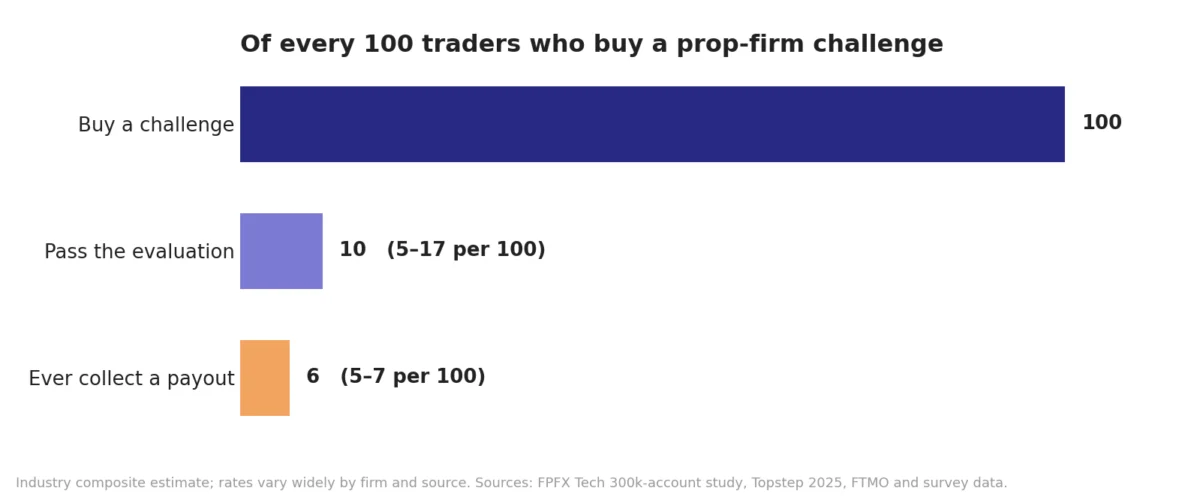
This funnel’s efficacy hinges on a stark reality: a vast majority of participants do not pass. While audited data is scarce, as most firms do not publish such figures, credible estimates consistently show low success rates. These estimates typically address two distinct questions: the percentage of traders who pass the initial evaluation, and the even smaller percentage who ever actually collect a payout.
Industry data, compiled from various sources including firm-published statistics, community estimates, and third-party platform analyses, paints a clear picture. For forex-focused firms, roughly 5-10% of entrants successfully pass the evaluation phase, with a mere 5-7% ever collecting a payout. Futures trading, often more rule-driven, shows slightly higher, though still challenging, success rates. For instance, FTMO community estimates suggest approximately 8% pass Phase 1, with around 7% of all entrants ever collecting a payout. Topstep, a firm-published statistic, showed 16.8% passing their 2025 Combine, but only 33% of funded traders (a much smaller pool) ever collected a payout. A third-party FPFX Tech study of 300,000 accounts found only 7% collected a payout, while the CEO of The Funded Trader stated 1-2% of all clients ever received a payout. The widely cited headline that "1 in 20 traders pass" is generally accurate for forex firms, illustrating the challenging odds faced by buyers.
Therefore, the underlying economics are straightforward: most customers fail their evaluations, making their initial fee largely gross margin for the firm. The small minority who succeed are paid from the much larger pool of fees generated by the failures. As long as the cumulative fees from unsuccessful attempts exceed the payouts to winners, the firm generates significant profits. This fee-based funnel, rather than any sophisticated trading strategy, forms the bedrock of the prop trading business model.
The Hidden Layer: The B-Book Controversy
Beyond the evaluation fees, a second, often opaque, layer of profit exists, conspicuously absent from marketing materials. The initial challenge phase is, by design, a simulation; orders placed during this period do not interact with real markets. The critical question arises after a trader is declared "funded." Even then, their trades frequently do not reach a live market. Instead, the firm "internalizes" them, a practice known as "B-booking." If the funded trader loses, which statistically is the most common outcome, the firm directly retains those losses, adding to its profits beyond the initial evaluation fee. This B-book mechanism is identical to a practice retail forex brokers have employed for decades, proving profitable for prop firms precisely because most accounts ultimately incur losses. It acts as an additional profit stream, complementing the fee funnel rather than replacing it.
Conversely, an "A-book" strategy involves the firm passing a trader’s orders directly to a real market venue, earning only a spread or commission. Firms typically A-book traders they believe will be consistently profitable, thus avoiding exposure to their potential gains. They B-book traders deemed likely to lose, directly collecting their losses. The strategic decision of assigning a trader to either the A-book or B-book is paramount. It is also where the most significant conflict of interest resides: a firm that B-books a trader has a direct financial incentive for that trader to lose. The documented failure mode, exemplified by the CFTC’s charges against MyForexFunds, involves a firm B-booking a winning trader and then fabricating a rule violation to close the account before having to disburse substantial payouts.
Historically, this B-book operation has been a closely guarded secret within the industry. Firms either outright denied its existence or simply omitted any mention of it. However, the emerging onchain entrants are adopting a radically different approach. They explicitly describe their A/B booking engine in their public documentation, with one notable instance even open-sourcing the classifier code that determines a trader’s book assignment. The inherent conflict of interest has not been eliminated, but its existence has been brought into the public domain.
The Onchain Migration: Drivers and Timing
The fundamental technological substrate enabling this shift to onchain prop firms is Hyperliquid. A successful prop trading operation demands several key capabilities: deep liquidity across a diverse range of markets, rapid execution speeds, and a robust, programmatic system for settling trades and issuing payouts. Hyperliquid addresses the first two requirements through its innovative onchain order book and extensive perpetuals markets. Furthermore, its builder-deployed framework allows external teams to deploy custom markets and tooling atop its infrastructure without needing to rent or build proprietary infrastructure. A prop firm leveraging Hyperliquid gains access to substantial liquidity, particularly in major crypto assets, without the prohibitive cost and complexity of building its own matching engine. Crucially, it inherently inherits the chain’s transparency, making every trade, every rule, and every payout a potentially verifiable onchain event.
Beyond technological innovation, there’s a significant defensive rationale driving the timing of this onchain migration. The traditional prop trading industry has long relied heavily on MetaTrader, a widely used trading platform. In 2024 and 2025, a stringent licensing crackdown by MetaQuotes, the platform’s vendor, reportedly forced an estimated 80 to 100 firms out of business – representing approximately one-eighth of the global total. This episode highlighted a critical structural vulnerability: a business whose core trading infrastructure can be unilaterally disabled by a software licensor faces existential risk. An onchain venue, with settlements recorded on a public blockchain that no single entity can revoke or control, offers an explicit counter-narrative to this fragility.
This last point forms the core value proposition of onchain prop firms. They aim to address three historical areas where prop firms have been able to operate with opacity and ambiguity: the rulebook, payout reliability, and the identity of the counterparty. By moving these elements onchain, they are dragged into the open, albeit to varying degrees of verifiability.
It’s important to maintain a nuanced perspective. While elements like payout reserves and rulebooks can be genuinely verifiable onchain, the routing of any single trade may not be fully provable. The fact that a firm can A-book to Hyperliquid does not automatically provide irrefutable proof that a specific trader’s fill was mirrored there rather than internally B-booked. Similarly, the exact promotion threshold for a trader to move from the B-book to the A-book might not always be public. Therefore, "disclosed" is often a more accurate term than "verifiable" when discussing the A/B decision specifically. Nevertheless, the act of explicitly disclosing this conflict represents a fundamental departure from the practices of firms like MyForexFunds, and it is a critical aspect to consider within this emerging category.
Key Players in the Onchain Prop Firm Arena
The onchain prop trading landscape is nascent but already shows signs of consolidation and significant interest. A notable development occurred outside the immediate crypto-native sphere in September 2025, when Kraken, a major cryptocurrency exchange, acquired Breakout. Breakout, a Tampa-based crypto prop firm, had already issued over 20,000 funded accounts since 2023. This acquisition marked Kraken as the first major crypto exchange to directly enter the funded trading space, signaling that prop trading is evolving into a desired feature for large exchanges, rather than remaining a fringe experiment. Two newer entrants, both built natively on Hyperliquid, represent the clearest expressions of the pure onchain model.
Propr, developed by XBorg and supported by SwissBorg, officially launched in early 2026. It offers funding for traders up to $100,000 to trade perpetuals across a diverse range of assets, including crypto, equities, and commodities, alongside prediction markets and Solana memecoins. Traders operate on an 80/20 profit split, with onchain payouts. Propr’s most distinctive innovation is its commitment to transparency, pushing it to its logical conclusion: it open-sources its A/B booking classifier, making the actual code that determines a trader’s book assignment publicly auditable. Its API documentation is also openly published. Propr successfully raised a $1.5 million seed round at a $17.5 million Fully Diluted Valuation (FDV), and its native $PROPR token is slated for a full unlock at a Token Generation Event (TGE) in August 2026. XBorg is also pursuing a "license the prop firm OS" business model, selling its underlying stack to other operators, which indicates where it perceives the highest profit margins within this ecosystem.
Hypernova launched its closed alpha on May 1, 2026, and secured $3 million in a pre-seed funding round led by Lemniscap, with participation from CMS Holdings, Very Early Ventures, Pivot Global, and a roster of prominent Hyperliquid-ecosystem angels. Hypernova employs a split architecture: its smart contracts, user accounts, and payout mechanisms reside on Arbitrum, settling in USDC, while liquidity and pricing are sourced from Hyperliquid’s extensive offering of over 110 perpetuals, covering crypto, US equities, commodities, and indices. The team boasts a strong pedigree, with experience from RockawayX and Coinbase. Notably, CEO Anar Bayramov was an early backer of Breakout during his time at RockawayX, prior to its acquisition by Kraken. As of late May, the alpha program had onboarded approximately 250 traders, funded over 20, and disbursed more than $30,000 in payouts, supported by a $1 million onchain payout reserve carved out from its funding round.
Beyond these three leading entities, a growing long tail of onchain prop firms is emerging, including names like HyperPnL, Upscale Trade, GT Funded, Solana Funded, and Carrot Funding. These are tracked by aggregators such as onchainprop.wtf, though users are advised to exercise caution and verify information directly from primary sources, as discrepancies (e.g., profit split percentages) can occur. One builder involved in selling the underlying tech stack has boldly predicted the emergence of over 100 onchain prop firms within a year. Regardless of whether this specific number materializes, the trajectory is clear: this category is expanding rapidly, attracting significant institutional capital, and moving beyond a handful of cloned projects.
| Breakout (Kraken) | Propr | Hypernova | |
|---|---|---|---|
| Stage | Live; acquired by Kraken Sept 2025 | Live since early 2026 | Closed alpha (launched May 1, 2026) |
| Venue | Kraken infrastructure | Hyperliquid | Arbitrum settlement + Hyperliquid liquidity |
| Instruments | Crypto | Perps (crypto, equities, commodities), prediction markets, memecoins | 110+ perps (crypto, US equities, commodities, indices) |
| Account size | Up to $200K | $10K–$100K | $5K–$200K |
| Profit split | Up to 90% | 80% | Up to 80% |
| Evaluation | Challenge → funded | 1-step or 2-step → funded | 1-step assessment, 10% target |
| A/B booking | Not disclosed | Open-sourced classifier (public repo) | Dynamic by trader quality; confirmed by CEO |
| Token | None | $PROPR, TGE Aug 2026 | Planned (raise had token warrants) |
| Funding | Acquired by Kraken | $1.5M seed @ $17.5M FDV | $3M pre-seed, led by Lemniscap |
Figures are drawn from each firm’s documentation and public coverage as of mid-June 2026. Account sizes and fees vary by tier, and alpha numbers, in particular, are subject to change. Breakout, now under Kraken ownership, is included as a centralized contrast to highlight industry consolidation rather than as a direct onchain peer.
The B-Book, Now on the Record: A Shift in Posture
Perhaps the most significant philosophical shift within this emerging category is not merely technological but cultural. The A/B booking conflict, the very issue MyForexFunds was charged for obscuring, is now often presented as a key differentiator and even a marketing point.
Anar Bayramov, CEO of Hypernova, articulated this mechanism to The Block without euphemism. He explained that when a trader is A-booked, the firm routes their trades to the real market and incurs a loss if the trader loses. Conversely, when a trader is B-booked—either due to insufficient data or an assessment of their trading performance as weak—the firm keeps those trades in-house and directly profits from their losses. The implication is clear: unproven or struggling traders are internalized, while consistently strong traders are routed to live markets. Bayramov framed this as a solution to the malpractice of legacy firms that B-book all traders and then arbitrarily ban successful ones, a scenario mirroring the MyForexFunds allegations.
Propr takes this transparency a step further by open-sourcing its classifier code. This allows for external auditability of the logic that sorts traders, moving beyond mere assertion. In both approaches, the underlying premise remains consistent: a conflict of interest that is openly acknowledged, and in Propr’s case, inspectable line by line, is inherently safer than one shrouded in secrecy and requiring blind trust in a support desk. There is merit to this argument. A B-book breach that can be verified against an immutable onchain rulebook is far more difficult to fabricate than one adjudicated within a private, centralized dashboard. While the firm still profits when a B-booked trader loses, it is theoretically prevented from retroactively altering the rules to ensure that outcome.
The honest assessment is that onchain prop firms have not fundamentally resolved the conflict of interest inherent in B-booking. Instead, they have made it legible. Furthermore, they have made the A-book a real possibility for qualifying traders, as opposed to MyForexFunds’s mere pretense. This constitutes a genuine improvement over the MyForexFunds model on two crucial fronts: explicit disclosure and actual trade routing. However, neither of these equates to perfect alignment of interests. A B-booked trader is still trading against a house that benefits from their losses. The crucial difference now is the ability to ascertain which side of that dynamic one occupies.
What Onchain Genuinely Fixes and What Persists
It is important to delineate the aspects that are structurally enhanced by onchain implementation from those that remain fundamentally the same business, albeit with improved optics.
Genuinely Improved: Payout reliability and rule integrity stand out as areas of significant structural enhancement. The most frequent and severe complaints against legacy prop firms revolve around payout issues, ranging from sluggish withdrawals to manufactured rule breaches or even outright firm disappearances. An immutable onchain rulebook and a publicly auditable payout reserve directly address these concerns. When a firm like Hypernova’s reserve balance is readily queryable on a block explorer, the question of "are they solvent enough to pay me?" transforms from an act of faith into a verifiable fact. Similarly, when breach conditions are embedded within a smart contract, "did I actually break a rule?" ceases to be a subjective judgment call and becomes an objective, onchain event. For the customer, this increased certainty and transparency represent a substantial and non-trivial value proposition.
Not Improved, and Arguably Sharpened: The underlying base-rate economics of prop trading remain unchanged. Whether onchain or off, the model’s profitability still hinges on the majority of traders failing their challenges. The drawdown limits, essential for the firm’s solvency, are the very same limits that typically lead to the washout of most accounts, often due to a single adverse trading day. The success funnel for onchain firms is unlikely to differ structurally from its legacy counterparts, where approximately 5-17% pass the evaluation and an even smaller fraction (5-7%) ever collect a payout. This is because the same profit target and drawdown mathematics drive both. While transparency fosters trust, it does not inherently improve a trader’s odds of success. A 10% profit target within a 6% drawdown limit remains a challenging examination, regardless of whether it’s enforced by a smart contract or a human compliance team.
The Same Old Risk, Now in Plain Sight: The solvency of the payout reserve presents a familiar risk, now rendered transparent. Legacy firms typically paid winners from a general corporate balance sheet, and when funds ran low, many simply vanished, defaulting on trader obligations. An onchain firm, however, pays from a specifically named, finite reserve. Hypernova’s $1 million reserve, for instance, is seeded from its fundraising and intended to be replenished through revenue. While adequate for a small funded book, a finite reserve acts as a hard ceiling in a way a general balance sheet does not. A cluster of simultaneous winning traders, or a highly successful A-booked cohort, can directly and rapidly deplete this reserve. The risk of insolvency itself is not new; what is novel is the ability to monitor the reserve’s depletion in real-time. Hypernova’s daily payout cap during its alpha phase, $10,000 of profit per user per day, serves as a visible pressure-release valve designed to manage precisely this constraint. Transparency, in this context, cuts both ways: when the reserve is public, a rapid draw-down or "run" on it becomes a publicly observable event.
The Nuanced Lesson of MyForexFunds
It would be a facile interpretation to view the MyForexFunds case as definitive proof that the entire prop trading model is inherently flawed, or that moving onchain is merely a tactic to evade regulators by operating offshore. Such a reading misrepresents both the specifics of the case and the actual regulatory risks.
The CFTC’s legal theory was highly specific. The actionable conduct centered on deliberate misrepresentation (telling customers they faced third-party liquidity while the firm was the counterparty), intentional manipulation of execution quality, and the pretextual closing of winning accounts. The CFTC did not argue that "being the counterparty" in itself was illegal, nor that "running a challenge" was prohibited. A firm that accurately discloses its counterparty, routes verified flow to legitimate venues, and enforces breaches through transparent, onchain logic effectively neutralizes the majority of the CFTC’s original complaint. In this narrow, crucial sense, the onchain design offers a more robust answer to the CFTC’s actual concerns than the "offshore-and-hope" posture adopted by many legacy firms.
Furthermore, the MyForexFunds case took an unexpected turn that complicates easy conclusions. In May 2025, the case collapsed. Following a recommendation from a court-appointed Special Master, who found that the CFTC had taken "deliberate steps down a path of obfuscation and avoidance," a federal judge dismissed the case with prejudice. The agency was ordered to pay the defendants’ legal fees for the sanctions motion, and four CFTC lawyers along with an investigator were placed on administrative leave. The very enforcement action that significantly shaped the perceived risk profile of this industry did not merely stall; it was entirely dismissed, with sanctions leveled against the regulator itself. This outcome does not condone the underlying conduct alleged against MyForexFunds, but it strongly suggests that the regulatory boundary is drawn around deception and execution abuse, rather than the prop trading model itself. This is precisely the line an ethically designed onchain firm is best positioned to respect.
The more challenging regulatory question is similar to those raised by HIP-4 for prediction markets or the "onchain forex gap" for FX: can a permissionless, no-KYC, offshore onchain venue truly scale beyond a niche, or will it be structurally excluded from the regulated institutional flow that larger players can access? Kraken’s acquisition of Breakout represents a strategic bet on the latter: that the compliant, exchange-backed version of prop trading is the one destined for mainstream adoption and scale.
Uncomfortable Questions for the Future
As the onchain prop firm category matures, several uncomfortable questions warrant careful consideration:
-
If transparency is the core product, why does the A/B booking logic often remain partly opaque? Propr’s decision to open-source its classifier is the strongest articulation of the transparency promise. However, if other firms like Hypernova describe the logic but do not publish the specific data thresholds that promote a trader from B-book to A-book, a gap in true verifiability remains. While disclosing the engine in plain language is an improvement over MyForexFunds, "trust our classifier" is not synonymous with "verify how it was applied to me." On a closed classifier, individual application cannot be independently checked onchain. The long-term credibility of this category depends on closing this transparency gap.
-
Is the payout reserve a feature or a fuse? A public, finite payout reserve is undeniably more honest than an opaque corporate balance sheet, but it is also inherently more fragile. Legacy firms that failed often did so quietly. An onchain firm whose public reserve visibly drains towards zero during a particularly profitable month for its A-booked traders faces a unique transparency problem that its predecessors never had to manage: a public run on its reserves.
-
Does placing the conflict onchain make it acceptable, or merely visible? A B-booked trader fundamentally remains in a position where they are trading against a house that profits from their losses. Disclosure, while vital, does not equate to alignment of interests. The open question is whether sophisticated traders, once they can clearly see they’ve been B-booked, will simply exit the platform. Such an exodus could leave firms primarily with the losing flow that makes the B-book profitable, thus exacerbating the very selection problem that could push firms towards MyForexFunds-style behavior in the first place.
-
Who ultimately wins as the category consolidates? Kraken, with its established distribution network and regulatory licenses, holds a powerful position. XBorg’s strategy of selling its underlying stack to other operators suggests a play for infrastructure dominance. The independent onchain firms sit in a middle ground, offering greater transparency than incumbents but facing scale challenges against exchange-backed behemoths. The vision of "100 onchain prop firms" and the reality of "one major exchange owns it" are not necessarily compatible.
The Core Takeaway
The onchain prop firm model represents a genuinely improved answer to the core problem MyForexFunds exemplified. The issue was never whether a firm could be the counterparty, but whether it should be allowed to hide that fact and cheat its customers upon exit. Immutable rules, publicly auditable payouts, and a transparently identified counterparty are significant advancements. The most credible iteration, exemplified by Propr’s open-sourcing of its A/B classifier, meaningfully raises the bar for industry standards.
However, the fundamental conflict of interest remains. Most traders continue to pay a fee and ultimately lose. Firms still profit from this losing flow and route winning traders to external markets. The drawdown limits, while ensuring firm solvency, are the same mechanisms that inevitably wash out the majority of participants. Onchain technology does not alter this basic arithmetic; it merely conducts it in public. For the individual purchasing a challenge, the expected value remains negative: a fee paid for a sub-10% chance of ever collecting a payout. A transparent negative-expected-value product is undoubtedly more honest than an opaque one, but it is not, by definition, a "better deal" in terms of probabilities.
The most clear-eyed perspective on this entire category is that it represents a form of gambling with an audit trail. This is an improvement over gambling without one, but it remains gambling. What is genuinely novel extends beyond marketing claims: the A-book is now a real pathway for traders who earn it, not merely a fiction; the rulebook cannot be arbitrarily rewritten after a win; and the payout reserve is a tangible asset that can be publicly monitored. The inherent conflict has not been solved; it has simply been relocated to a place where everyone can observe it.

