
The digital landscape is on the cusp of a profound transformation, shifting from an internet focused on automating tasks to one that automates intentions. This paradigm shift is anchored by the emergence of the "Agentic Layer" within what is being termed the "Post Web." This novel stratum of the technological stack envisions autonomous Artificial Intelligence (AI) agents acting as digital proxies for humans, capable of interpreting complex goals, making independent decisions, and executing actions across decentralized systems.
This evolution builds upon the foundation laid by Web3, which introduced a decentralized internet centered on ownership. Through the advent of smart contracts, the ability to automate transactions and agreements trustlessly between parties became a reality, paving the way for new financial and organizational infrastructures. While Web3 was characterized by programmable money, the Post Web is defined by programmable agency.
Greysen Cacciatore, Research Associate at Outlier Ventures, highlights the significance of this transition, stating, "AI agentic systems mark the beginning of a new paradigm. With their capabilities to orchestrate intention, navigate complex virtual environments, and achieve sophisticated outcomes, they are poised to transform the global economy." This assertion underscores the potential for AI agents to move beyond simple task execution to become sophisticated actors within the digital realm.
Understanding AI Agents: A Leap Beyond Bots
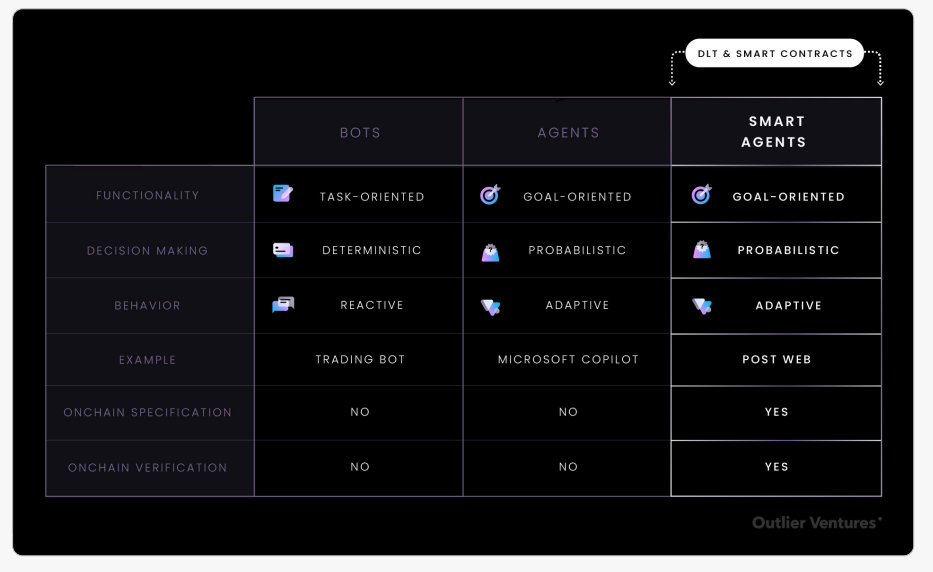
The term "AI agents" might initially evoke similarities to the ubiquitous bots and scripts currently populating the internet. However, the distinction is fundamental and represents a significant technological leap. Traditional bots are designed to follow a rigid set of predefined instructions, operating deterministically where a fixed input reliably yields a fixed output. They are typically task-based and reactive, executing actions only when prompted by specific triggers, and lack any inherent capacity for learning or adaptation.
In contrast, AI agents are characterized by their goal-oriented and adaptive nature. They are probabilistic systems, meaning their outcomes evolve dynamically based on context. This allows them to pursue overarching goals and adapt their strategies in real-time. Unlike bots, agents are intent-based and proactive, anticipating needs and opportunities. Crucially, agents possess a continuous capacity for learning and optimization, enabling them to refine their performance and decision-making over time.
The core difference can be distilled to this: bots automate tasks, while agents automate outcomes. This distinction transforms digital interaction from a static, command-driven process into a dynamic, living system that is responsive, context-aware, and capable of sophisticated reasoning. This capability for dynamic adaptation and learning was largely unattainable within the framework of the Web3 era.
Smart Agents: The Economic Vanguard of the Post Web
The Post Web thesis introduces a more advanced category of AI agents known as "Smart Agents." These are next-generation AI entities designed to interact directly with distributed ledger technology (DLT) and smart contracts. Unlike agents that might consume data via APIs, Smart Agents possess the capability to autonomously own tokens, sign transactions, and execute contracts.
In essence, Smart Agents are positioned to become the primary economic participants of the Post Web. They are equipped to manage digital assets, verify ownership, enforce agreements, and execute complex workflows in real-time. This capability is facilitated by a robust trust framework, incorporating two key mechanisms: [Placeholder for specific mechanisms as described in the source, e.g., verifiable credentials, decentralized identity solutions, robust oracle networks, etc., if available. As they are not explicitly detailed in the provided text, this section remains conceptual.] These mechanisms are designed to foster autonomous digital economies where human oversight and cryptographic verifiability are integrated seamlessly.
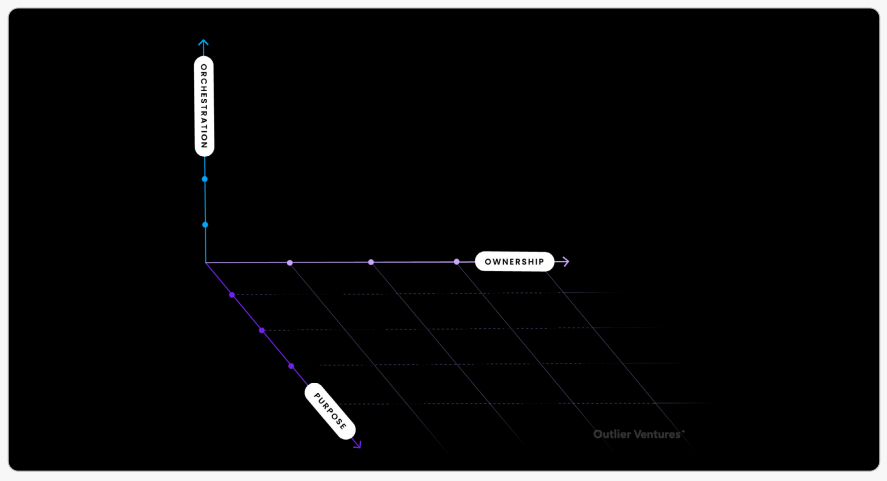
The classification of these Smart Agents is multifaceted, categorized along three key axes: orchestration, ownership, and purpose. This nuanced classification suggests a future internet that functions less like a network and more like a complex, thriving ecosystem populated by self-directing entities, all optimizing for efficiency, value creation, and sophisticated coordination.
From Automation to True Autonomy
In the era of Web3, smart contracts automated trust. They enabled the execution of agreements without intermediaries, but they still relied on human users to provide the intention – to write the code, initiate transactions, and manage the ultimate outcomes. The Post Web, through the development of smart agents, aims to automate intention itself.
These agents are designed to interpret goals expressed in natural language, determine the most effective course of action, and autonomously negotiate with protocols to achieve those objectives. This shift promises to unlock unprecedented possibilities. Imagine scenarios where a smart agent can autonomously manage a user’s investment portfolio, rebalancing assets based on market conditions and predefined risk tolerance, or another agent that can proactively secure travel arrangements and accommodations based on a user’s calendar and stated preferences, optimizing for cost and convenience. These are no longer theoretical constructs; they are becoming tangible possibilities.
The convergence of advancements in reinforcement learning, natural language processing models, and decentralized computing is giving rise to this "Agentic Layer." This new layer of the web is being architected to host, coordinate, and govern these intelligent actors.
The Significance of the Agentic Layer
The Agentic Layer represents a fundamental architectural evolution of the internet. It signifies a transition from passive user interfaces to active, autonomous participants. This shift carries profound implications:
- Enhanced Efficiency and Productivity: By automating complex decision-making and execution processes, the Agentic Layer can significantly boost productivity for both individuals and businesses.
- Democratization of Advanced Capabilities: Complex tasks that previously required specialized knowledge or significant effort will become accessible through intuitive intent expression to AI agents.
- New Economic Models and Opportunities: The emergence of autonomous economic actors will foster novel business models, investment strategies, and decentralized marketplaces.
This represents the Post Web: an intent-based, adaptive, and verifiable internet where humans, agents, and protocols collaborate in an economy of continuous coordination.
Interoperability: The Crucial Fabric of the Agentic Web
As the agentic web takes shape, a critical consideration for its architecture is interoperability. Chris Dixon aptly notes that the design of a network dictates who builds and who owns it. Protocol networks, characterized by their open, permissionless nature and reliance on shared standards, must take precedence over closed, rent-extracting corporate networks.
For the nascent agentic economy, this distinction is not merely ideological but practical. Without robust, interoperable standards, the risk of replicating the fragmentation that plagues the current internet is significant. The maturation of composable standards, such as those being developed by entities like Virtuals, is paramount. However, their evolution must adhere to a Web3 ethos: open-source development, transparency, and an anchoring on distributed ledgers to ensure agent accountability.
These protocols will serve as the connective tissue of the agentic web, enabling agents to coordinate, transact, and reason safely across diverse systems. Ultimately, the same principles that drove the decentralization of ownership in Web3 must now be applied to the decentralization of agency itself.
The Web Awakens: A Living Network
The Post Web is not merely the next iteration of digital infrastructure; it is envisioned as a living network. This is a web that understands, adapts, and acts. Where human programming once dictated the internet’s functionality, the future will involve humans simply expressing intent, with their agents handling the complex execution.
This evolutionary leap is poised to "transform how we interact with technology, data, and one another," fundamentally re-architecting the web to place agency at the very core of the digital experience.
Credits & Source
Content derived from The Post Web Thesis, Chapter 2: "Turning the Web3 Tech Stack into the Post Web Stack", Outlier Ventures (2025). Cited pages 39–46.
Readers interested in exploring this vision further can sign up for early access to The Post Web Thesis, Chapter 3: "Zero to Many," which is forthcoming.

