The Emergence of the Robotic Combatant
The transition to a more automated battlefield was highlighted by recent reports from the Ukrainian government, suggesting that robotic systems are no longer merely experimental tools but are now integral to frontline operations. Ukrainian President Volodymyr Zelenskyy recently claimed that a combination of ground robots and aerial drones successfully neutralized a Russian military position, eventually forcing the surrender of the defending soldiers. While independent verification of specific incidents remains difficult in an active war zone, the Ukrainian 3rd Separate Assault Brigade has provided detailed accounts of operations in the Kharkiv Oblast where "kamikaze" ground robots and flying drones were used in tandem to breach fortified defenses.
In one documented instance, Russian soldiers reportedly surrendered to a Ukrainian robot after their fortifications were systematically dismantled by remote-controlled strikes. This psychological and tactical milestone underscores a shifting reality: the "dirty, dangerous, and dull" jobs of infantry—trench clearing, perimeter defense, and point-blank assault—are being outsourced to silicon and steel.
According to data released by Ukraine’s Ministry of Defense and analytics shared by platforms such as United24, the scale of these operations is unprecedented. In the first quarter of 2026, Ukrainian military robots were credited with completing over 22,000 missions. Specifically, in March alone, the military conducted more than 9,000 UGV missions, marking a threefold increase in ground robot activity over a five-month period. This surge indicates that the industrial base for domestic robotics in Ukraine has reached a level of maturity capable of sustaining high-tempo combat operations.
Defining the Modern "Kill Zone"
The necessity for ground-based robotics is driven by the extreme lethality of the contemporary battlefield. The proliferation of First-Person View (FPV) drones and persistent aerial surveillance has created a "kill zone" that extends roughly 20 kilometers (12 miles) behind the forward edge of the battle area. Within this corridor, any movement by human personnel or traditional armored vehicles is immediately detected and targeted.
Military analysts note that drones are now responsible for the majority of battlefield casualties on both sides. This environment has forced human soldiers to adapt through extreme measures, such as moving only under the cover of dense fog, using anti-thermal cloaks to mask body heat, or restricting logistics to the deepest hours of the night. By deploying robots into these high-risk zones, the Ukrainian command seeks to break the paralysis caused by drone-saturated skies.
The latest generation of these machines is designed to operate in environments where electronic warfare (EW) is rampant. As both Russian and Ukrainian forces deploy sophisticated jamming equipment to sever the links between operators and their machines, developers are integrating autonomous, AI-powered software. these systems allow robots and drones to track targets and navigate terrain even when communication with human controllers is completely lost.
Technical Profile: The Droid TW 12.7
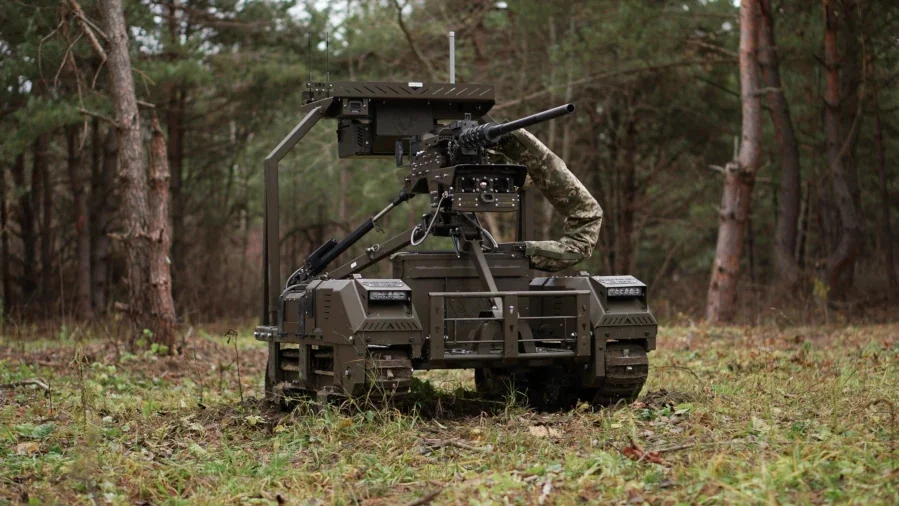
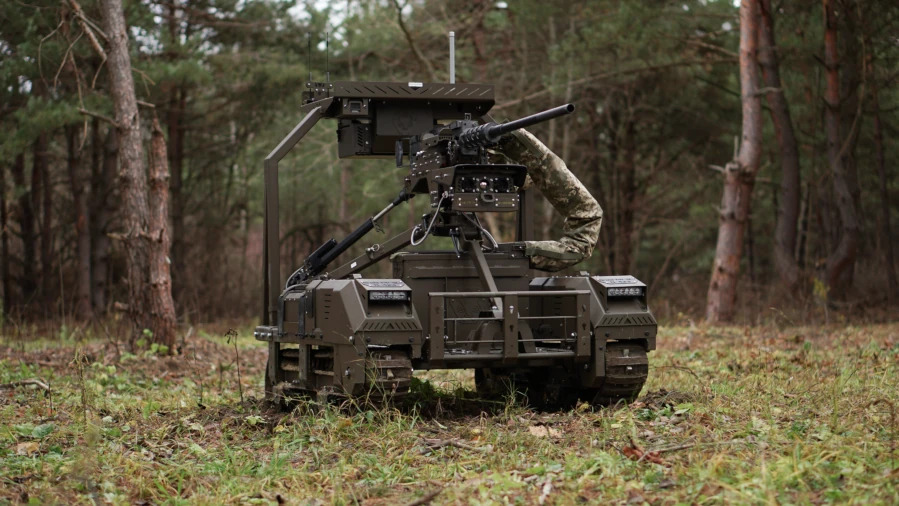
Among the most prominent examples of this new class of weaponry is the Droid TW 12.7, developed by the Ukrainian tech firm DevDroid. This uncrewed ground vehicle is a tracked platform designed specifically for fire support and defensive stabilization.
The Droid TW 12.7 features:
- Armament: A remotely controlled turret equipped with a 12.7mm M2 Browning machine gun, capable of suppressing infantry and light armored vehicles.
- Range and Endurance: The platform can travel up to 25 kilometers (15.5 miles) on a single deployment, allowing it to be staged well behind the immediate line of contact.
- Speed: It operates at a top speed roughly equivalent to a brisk human walking pace, ensuring it can maneuver alongside infantry or move stealthily through debris.
- Connectivity: The system utilizes a combination of radio links and Starlink satellite terminals, providing high-bandwidth video feeds to operators located kilometers away in hardened bunkers.
Beyond the Droid TW 12.7, Ukraine is deploying a diverse fleet of smaller "kamikaze" robots—low-profile, wheeled, or tracked chassis laden with explosives. These are used to drive directly into enemy bunkers or under parked vehicles, offering a ground-based alternative to the ubiquitous FPV drone.
Logistical and Humanitarian Applications
While combat-oriented robots garner the most headlines, the impact of UGVs on logistics and medical evacuation (MedEvac) is arguably more critical for long-term sustainability. In the "kill zone," the simple act of delivering ammunition or evacuating a wounded soldier can cost the lives of several more personnel.
Robotic mules are now being used to ferry supplies to isolated outposts, reducing the need for human-driven trucks that are easily spotted from the air. However, the transition has not been without significant hurdles. A deputy battalion commander from Ukraine’s 38th Marine Brigade recently noted that the success rate for robotic MedEvac missions remains inconsistent. In some sectors, robots attempting to reach wounded soldiers failed in four out of five attempts due to a combination of difficult terrain, mud, and targeted drone strikes by the adversary.
The battle-scarred landscapes of Eastern Ukraine—characterized by deep shell craters, tangled wire, and the infamous "rasputitsa" (mud season)—present a formidable challenge for wheeled and tracked robots. Unlike aerial drones, which can fly over obstacles, UGVs are often stymied by the very environment they are meant to navigate.
The Symmetrical Arms Race
Ukraine is not alone in its robotic ambitions. The Russian military has observed the effectiveness of these systems and has responded with its own surge in UGV deployment. Throughout the winter of 2025–2026, Russian forces began fielding increased numbers of small, armed ground platforms and automated logistics sleds.

This has resulted in a symmetrical arms race where robots are increasingly fighting other robots. Electronic warfare remains the primary tool for neutralizing these threats, leading to a constant cycle of software updates and frequency-hopping innovations. The Lowy Institute reports that signal loss remains the "Achilles’ heel" of current ground robotics, as the curvature of the earth and physical obstructions like buildings or hills make ground-to-ground radio links much more fragile than ground-to-air links.
Strategic Implications and the Future of Infantry
The ultimate goal of Ukraine’s robotic surge is a fundamental restructuring of the military’s human component. The commander of Ukraine’s 3rd Army Corps has suggested that by successfully integrating more robots into frontline units, the military could potentially reduce its infantry ranks by up to 30 percent by the end of 2026.
In a war of attrition where manpower is a finite and precious resource, the ability to replace a third of the frontline infantry with machines could be a decisive factor. This is not about the complete removal of humans from the battlefield, but rather a shift in the role of the soldier from a direct combatant to a system operator.
The implications of this shift extend far beyond the borders of Ukraine. Militaries worldwide—including those of the United States, China, and NATO members—are closely monitoring the performance of these systems. The lessons learned in the "kill zones" of Kharkiv and the Donbas are likely to dictate the procurement strategies of global powers for decades to come.
As the technology matures, the focus is shifting toward "swarming" capabilities, where multiple ground robots and aerial drones operate as a single, cohesive unit controlled by a minimal number of human supervisors. While the "Terminator" scenarios of popular fiction remain far-fetched, the reality of 9,000 robotic missions a month suggests that the age of autonomous warfare has arrived. For Ukraine, these robots represent more than just technological prowess; they are a vital necessity in a conflict where the cost of human presence has never been higher.